
The art world has abolished distance. Not borders.
The art world calls itself global. But what happens when works of art move more freely than the artists who make them? Can an international career be built from Africa? And what changes when success does not draw an artist away from Accra, Nairobi, Harare, Tamale or Nsukka, but instead enables them to build a new centre around where they are? This is the story of five internationally recognised artists, each connected to Africa in a different way: Amoako Boafo, Michael Armitage, Moffat Takadiwa, Ibrahim Mahama and El Anatsui.
African and Afro-diasporic art has become impossible to ignore at the most prestigious levels of the global art world. One milestone was When We See Us, presented at Zeitz MOCAA in Cape Town in 2022-23 and later at Kunstmuseum Basel in 2024. The same shift can be seen in major European and American solo exhibitions by Amoako Boafo and Moffat Takadiwa, Ibrahim Mahama’s first-place ranking in the 2025 ArtReview Power 100, and In Minor Keys, the central exhibition of the 2026 Venice Biennale, conceived by Koyo Kouoh and realised by her team after her death.
The question, then, is no longer whether an international artistic career can be built from Africa, but under what conditions this becomes possible, and what additional obstacles confront those who begin outside the art world’s traditional centres. For all its claims to globalism and democracy, the system still does not offer equal access. Inequality does not appear at only one point. It determines who is able to move, through which frameworks a work becomes legible, and where the institutional power generated by success ultimately accumulates.

An Accidental Artwork
During Art Basel week in June 2026, two neighboring stands at Africa Basel inadvertently coalesced into a single, chillingly precise artwork.
One displayed Richard Mudariki’s Art World Passport. The Zimbabwean-born, Cape Town–based artist’s passport-shaped booklet asks who is admitted into the institutional spaces of contemporary art and who remains outside them. It links unequal access to mobility with the systems of archiving, legitimacy, and participation that shape the global art world.
Only a few meters away, Uganda’s Umoja Art Gallery stood empty. The works had arrived in Basel, but the gallery’s two Kampala-based representatives were denied Swiss visas. Because Switzerland has no embassy in Uganda, they were required to travel to Nairobi to submit their applications. After a process lasting nearly two months, the refusals arrived less than a week before their scheduled departure. The artworks crossed the border. The people could not.

During the same week, Ghanaian artist Ibrahim Mahama unveiled The God of Small Things, a monumental public installation commissioned by Art Basel for Münsterplatz. The accompanying VIP program included a private lunch in his honor and an exclusive artist-led tour. While the visa system denied Umoja a physical presence, Art Basel simultaneously offered Mahama’s presence as a privileged experience. The two extremes of the same mobility regime became visible at once.

No curator could have staged the contradiction with greater precision. A year earlier, Mudariki himself had been unable to reach Basel after Switzerland refused his visa application despite two formal letters of invitation. His work—an examination of unequal cultural mobility—was represented through a video link. In 2026, he was finally present, while absence had shifted to the neighboring stand. Bureaucracy seemed to be writing a new chapter of the project with each passing year.
The episode unsettles familiar assumptions about global artistic success. A work may circulate through the world’s leading fairs, galleries, and museums without its maker becoming an equal participant in the art world that exhibits it. Art can travel freely across borders even when the artists and cultural workers who sustain it remain unable to do the same.
The Crate Gets Through. The Body Gets Stuck.
The contemporary art world likes to describe itself as open, democratic and without borders. The movement of artworks can sustain that illusion. They are packed, insured, cleared through customs and shipped, then appear on a wall on another continent a few days later. The artist must prove much more. Why do they want to travel? How will they pay for the journey? Where will they stay? What evidence is there that they will return when the programme ends? The object is presumed to have value; the person is assessed as a risk.
This does not mean, of course, that artists living in Africa do not travel. Artists at every stage of their careers attend residencies, biennials, workshops and exhibitions abroad. Many receive visas and build international relationships while keeping their base in their own country. The real inequality lies in whether movement is predictable, repeatable and embedded in professional life. A one-off journey is not the same as freedom of movement.
For an emerging artist, a trip may depend on a single residency invitation, scholarship, sponsor, proof of sufficient funds and an individual visa decision. At the current stage of the careers of Amoako Boafo, Michael Armitage, Moffat Takadiwa and other internationally established artists, regular international presence is supported by established galleries, institutional relationships, substantial financial resources and accumulated professional credibility. Success changes mobility itself: what was once an exceptional opportunity can become a reliable part of professional life. Success does not dismantle the border, but it gives the artist greater leverage when they reach it.
Professional prestige, however, offers no guarantee of free movement. Richard Mudariki’s experience in 2025 showed that the credibility accumulated within the art world does not automatically become trust at a national border.

Nor is it a matter of social protocol whether an artist is able to attend their own opening. Fairs, dinners, studio visits and informal conversations are where relationships are formed, relationships that later become invitations, museum acquisitions and collaborations. The absent artist’s work may remain visible and saleable, but the artist cannot enter the space in which the next opportunity is taking shape. Mobility is therefore not merely a consequence of success. It is one of the means by which success is produced.
The Western Canon as a Passport
Unequal access to mobility is only one obstacle on the road to international recognition. It is not enough for a work to reach the physical centres of the global art system. It must also enter the interpretive order that determines what can become legible, significant and, eventually, canonical. Although the contemporary art world likes to imagine that it has moved beyond Eurocentric narratives, Western institutions still often translate what does not fit their familiar categories into their own art-historical language. The new is admitted by first being made to resemble something the system already knows and has validated.
Gustav Klimt and Egon Schiele repeatedly appear in the reception of Amoako Boafo. Writing on Michael Armitage often invokes Titian, Francisco Goya, Édouard Manet, Paul Gauguin or Vincent van Gogh. Boafo studied at the Academy of Fine Arts Vienna, and the expressive portraiture of the Viennese Secession did influence him. Armitage completed his art education in London and deliberately quotes, revises and reverses images inherited from the European canon. These comparisons are real, and they can open important layers within the work.

The problem is not that the comparison exists, but that it tends to move in only one direction. Institutional reception treats Klimt as self-evident, as an artist whose universal importance requires no explanation, while Klimt or Schiele often provides the point of entry into Boafo’s work. Van Gogh does not need an East African painter to legitimise him; Armitage, by contrast, is accompanied by Van Gogh, as though a familiar Western name must vouch for the unfamiliar artist. At this point, the canon no longer offers context. It sets an entry requirement. The comparison becomes a cultural visa, certifying that the work may enter an already authorised history of art.
Yet if Boafo’s portraits are read as contemporary versions of Schiele populated by Black sitters, their own social world disappears. Circles of friends in Accra and across the diaspora; self-determination articulated through dress; and the gesture through which Boafo presents the Black body not as an ethnographic sign or exotic spectacle, but as a confident and autonomous presence. The Viennese reference is real, but it is only one possible entrance into the paintings.

The limits of Western comparison are even clearer in Armitage’s work. Goya and Gauguin matter, but so do East African modernists, popular visual culture, Kenyan political events, folklore and the artist’s own visual memory. Even the support of the paintings, lubugo bark cloth produced in Uganda, carries an East African history into the work, while its irregular surface, holes and seams actively shape the composition.
This is what made Paradise Edict, Armitage’s 2020 exhibition at Haus der Kunst in Munich and his first major museum presentation, such an important turning point. Around seventy works by twentieth-century East African artists were shown at the end of the exhibition, placing Armitage’s paintings in direct conversation with the local generations that preceded him. Behind what had previously appeared primarily as an “international” painterly language, a local art history suddenly became visible. The exhibition did not invent a new context for Armitage’s work. It revealed a genealogy that had largely remained outside Western reception.

Can Western institutions interpret something that has no reference point in Western art history? The question itself reproduces the hierarchy it is trying to examine. No work is without references. There are only references that the dominant viewer does not recognize because they have never learned to see them. The absence, in such cases, lies not in the work but in the viewer’s knowledge.
This blindness can easily hide behind formal admiration. El Anatsui’s monumental works can readily be admired as “metal tapestries” or abstract surfaces. The description is not wrong, but it is incomplete. The bottle caps are not neutral recycled materials: they carry memories of colonial trade routes, the transformation of alcohol into an international commodity, and the historical entanglement of Africa, Europe and the Americas.
In Moffat Takadiwa’s woven wall sculptures, dismantled computer keyboards do more than create compelling patterns. They take apart the power of the English language and a Western-oriented education system, then use the letters to construct a new, “decolonized” language. Ibrahim Mahama’s jute sacks may be compared to the material vocabulary of Arte Povera or the repetitive structures of Minimalism, but their primary archive is Ghanaian labor and commodity circulation: the passage of cocoa, charcoal and other goods, and the traces of the people who used, mended and passed the sacks on. In each case, a Western analogy may describe the form, but it cannot exhaust the work’s historical experience.

The Western gaze can understand these works, but not by using its own canon as the only available translation machine. Western art history need not be discarded; its claim to exclusivity does. It is not the work’s responsibility to request admission in a language that is already familiar. Sometimes it is the viewer who must cross the border.
The Geography of Global Success: Five Careers, Five Models
The inequalities of mobility and interpretation reveal the structural obstacles that shape careers emerging from Africa. These five trajectories show how international success is actually built. Where an artistic language takes form, which encounter or institutional appearance produces a breakthrough, whether relocation becomes necessary, and where an artist’s lasting base remains. The routes are different, but none is independent of the possibility of movement or the recognition of the international art system.
El Anatsui: Four Decades Before a “Sudden” Breakthrough
El Anatsui’s career radically contradicts narratives of rapid discovery. After studying in Ghana, he moved to Nigeria in 1975 and joined the Department of Fine and Applied Arts at the University of Nigeria, Nsukka. His first solo exhibition was held there in 1976. His artistic language and professional environment were therefore formed in West Africa.
By 1990, Anatsui had already appeared at the Venice Biennale. Yet his wider breakthrough came in 2007, when his monumental works were shown in the Biennale’s central exhibition and at Palazzo Fortuny. He was sixty-three years old and had been working in Africa for nearly four decades. He did not need to relocate to a Western centre to create this body of work. Instead, the international art system turned towards a practice that had already been built, over many years, in place.
Ibrahim Mahama: A Local Practice and an International Curatorial Bridge
Ibrahim Mahama’s story is an accelerated version of this trajectory. He studied at KNUST in Kumasi and realised his early jute-sack installations in Ghanaian markets and public buildings. His material language, collective working methods and inquiry into the history of commerce had taken shape well before international recognition arrived.
The turning point was Okwui Enwezor’s 2015 Venice Biennale. Out of Bounds, covering the walls of the Arsenale with used jute sacks, made a practice developed in Ghana visible on a global scale. Documenta 14, representation by White Cube and a series of major institutional commissions followed. Mahama did not have to relocate abroad to sustain an international career. But he did need a curatorial and institutional bridge capable of bringing a locally developed practice into global circulation.
Moffat Takadiwa: Step by Step from Harare
There is no single, transformative moment in Moffat Takadiwa’s career. After graduating from Harare Polytechnic, he held his first major solo exhibition at First Floor Gallery Harare in 2012, having also played an important role in the gallery’s foundation. His artistic language, built from computer keys, bottle caps, toothbrushes and other remnants of consumption gathered from Harare’s dumps, had already developed in Zimbabwe.
His international presence emerged gradually through a sequence of local, regional and global platforms. Connections in South Africa followed his beginnings in Harare, then came his first London solo exhibition in 2015. His participation in the Zimbabwe Pavilion at the 2024 Venice Biennale and Art Basel Unlimited in 2026 were not sudden discoveries, but stages in a long process of accumulation. Throughout, Takadiwa kept his studio and artistic base in Harare. His career shows that success does not necessarily require emigration, but one invitation is never enough: mobility must become repeatable, and relationships must become durable.
Amoako Boafo: Begun in Accra, Accelerated in Vienna
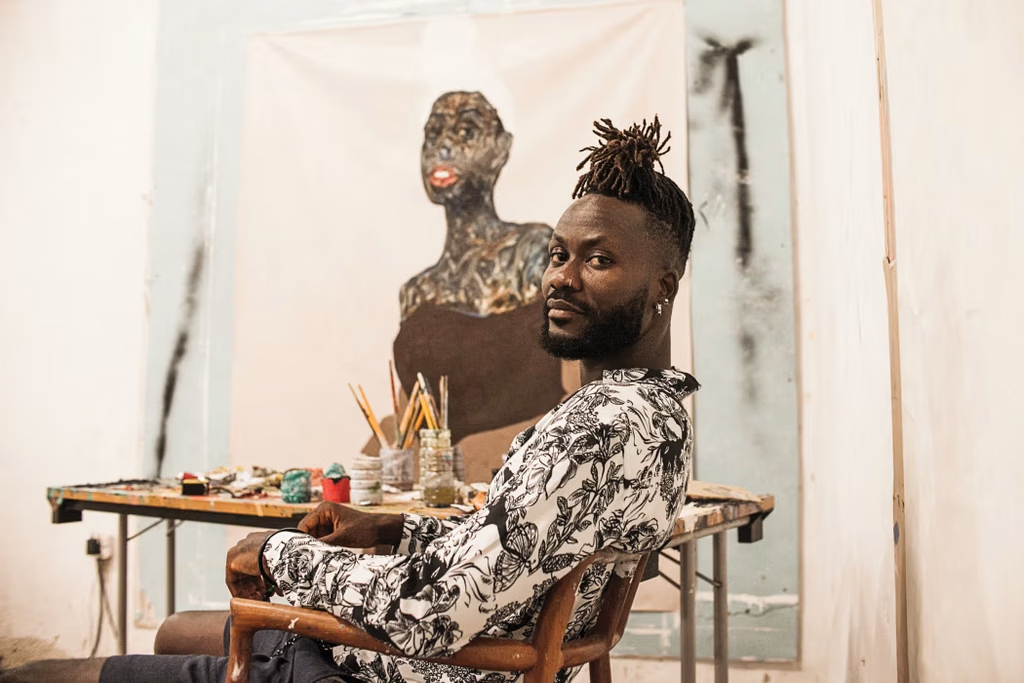
Amoako Boafo’s story cannot be described solely as a career built in Africa. After graduating from the Ghanatta College of Art and Design in Accra, he began exhibiting locally. In 2013, however, he moved to Vienna and later continued his studies at the Academy of Fine Arts. The move was more than a change of location. It gave him access to a European academy, professional networks and a cultural environment from which his work could enter the international field of vision more easily.
Yet the decisive turn came not from a traditional institution, but from social media. Kehinde Wiley discovered Boafo’s paintings on Instagram in 2018 and recommended him to galleries in the United States. A Los Angeles exhibition and a residency at the Rubell Museum the following year marked his international breakthrough, followed by a dramatic rise in auction prices. In Boafo’s case, market success preceded and partly shaped his broader museum reception. Once his international career had consolidated, Accra again became one of his principal bases.
Michael Armitage: A Career Built in London, an East African Centre
The role of educational infrastructure outside the continent is even clearer in Michael Armitage’s case. Born in Nairobi, he completed his higher art education in London at the Slade School of Fine Art and the Royal Academy Schools. His first decisive institutional and market networks were formed not in Kenya, but in Britain.
His 2015 solo exhibition at White Cube was followed by presentations at the South London Gallery, the Venice Biennale, MoMA and Haus der Kunst. The accumulation of a London education, support from a leading international gallery and museum recognition made Armitage’s career global. Yet the subjects and visual sources of his painting remain consistently connected to East Africa, while Nairobi continues to be one of his artistic centres. His is not the story of an African body of work discovered late, but of a career built across several geographies.

These five stories do not reveal a single “African” route to global success. Anatsui’s university and studio environment, sustained over decades; Mahama’s locally developed practice amplified through a curatorial breakthrough; Takadiwa’s gradual internationalisation; Boafo’s market ascent accelerated by migration and social media; and Armitage’s career built through London education and institutional networks represent five different models.
What they share is not emigration, but entry into international circulation. Anatsui, Mahama and Takadiwa did not have to leave Africa permanently. In the cases of Boafo and Armitage, however, education and professional networks outside the continent played a decisive role. An artistic practice can be built in Nsukka, Kumasi, Accra or Harare, but the seal of global recognition is still usually conferred in Venice, London, New York or Los Angeles.
At this point, another question becomes urgent. W
hat happens to the financial, social and institutional capital accumulated within the international system? Does it break away from the environment in which the career began, or does it return and become an opportunity that others can access locally?
Success Comes Home: When the Artist Becomes an Institution
Perhaps the most radical moment in these careers is not the rise to international prominence, but what follows. The successful artist begins to reinvest money, attention, relationships and institutional knowledge in the place they call home. It is as though the next work in the artist’s career were the infrastructure itself.
In 2022, Boafo opened dot.ateliers in Accra. It offers exhibition space, studios, a library, a residency programme and a place to meet, with particular emphasis on non-commercial experimentation and international knowledge exchange. Its aim is not simply to support younger artists. It is to ensure that Ghana is not merely a place from which the global market extracts talent, but a centre to which others come to work.
Armitage founded the Nairobi Contemporary Art Institute in the Kenyan capital. Alongside contemporary art, NCAI’s exhibitions, archive, library and research programmes preserve the histories of twentieth-century East African artists. This responds directly to the fact that even art students in the region often know little about their own modernist predecessors. Armitage is using the resources of global success to build not only new exhibition opportunities, but also a local art-historical memory.
Takadiwa’s Mbare Art Space operates in a repurposed beer hall dating from the colonial era in Harare. It provides studios, mentorship and public programmes, while connecting art practices based on discarded materials to a wider ecological and social conversation.
Mahama opened the Savannah Centre for Contemporary Art in 2019, the Red Clay Studio and research centre in 2020, and Nkrumah Volini in 2021. Together, they form an ecosystem for exhibitions, research, education and residencies. Abandoned silos, railway carriages and aircraft become archives, classrooms and community spaces. When ArtReview placed an artist based on the African continent at the top of its Power 100 for the first time in 2025, Mahama’s position recognised not only his artworks, but this work of building infrastructure.
El Anatsui’s model is less visibly institutional, but no less significant. Through more than four decades of teaching in Nsukka, his studio community, assistants and students, the transfer of knowledge began long before “giving back” became an expected programme for successful artists. Community infrastructure need not be a building. It can also be a pedagogical presence, a workshop and a professional culture passed from one generation to the next.
These initiatives reverse the customary direction of mobility. The young artist in Accra, Nairobi, Tamale or Harare does not always have to secure a visa before entering an international conversation. The curator, resident artist, researcher or collector comes to them. Individual mobility is transformed into an opportunity that becomes locally available to others.
Yet the question “How do I give back?” is not politically neutral. Artist-led spaces demonstrate the power of artists, but they also expose the absence of adequate public and institutional infrastructure. They can be fragile in the long term when their survival depends on the market success of a single individual. Even so, this is not simply philanthropy. These artists are, in part, building for others the institutions they themselves once lacked. Individual success becomes shared infrastructure.

Who Gets to Travel in the End?
It is possible to build an internationally recognised artistic career from Africa, and to exhibit around the world while keeping Accra, Nairobi, Harare, Tamale or Nsukka as a base. But this is not possible because geography has ceased to matter. It is possible because a small number of artists have been able to connect local knowledge and materials to the global infrastructure of galleries, institutions, transport systems and personal networks.
The decisive question is therefore not whether the artist stays or leaves. It is whether they are free to determine their own movement; whether remaining in place must also mean remaining invisible; and whether international success can change the direction of traffic.


